 Skip to content

Sometimes. You may need Category D1 or D entitlement to drive a minibus, but some drivers can use an existing car licence under specific conditions. The answer depends on your current entitlement, the vehicle and how the journey is organised. Hiring a minibus with a driver is different: as a passenger or group organiser, you do not need a minibus driving licence yourself.
If you are asking "do you need a special license to drive a minibus", start with the vehicle’s passenger capacity and your actual licence record. A booking description such as "17-seater" does not tell you enough on its own. Our minibus driving licence guide explains the categories in more detail.
Guidance checked on 16 October 2026. The main licence-category guidance below concerns Great Britain. Northern Ireland drivers should also check nidirect guidance.
What does "special licence" mean for a minibus?
There is no single document called a special minibus licence. People usually mean an additional driving entitlement:
| Entitlement | What to check |
|---|---|
| Category B | Normally covers vehicles with up to eight passenger seats, within the applicable weight limits. A conditional minibus exception may apply to some voluntary journeys. |
| Category D1 | Covers vehicles with no more than 16 passenger seats and a maximum length of eight metres; a trailer may weigh up to 750kg. |
| Category D | Covers buses with more than eight passenger seats, including vehicles outside the D1 passenger-capacity limit. |
| Category D1E | Relevant to D1 vehicles towing trailers above 750kg, subject to the category’s limits. |
These are driving categories, not proof that every commercial operation is authorised. Check your entitlement against GOV.UK’s driving licence categories, including any restrictions.
When can a car licence cover minibus driving?
The GOV.UK minibus guidance sets out a conditional route for car-licence holders driving vehicles with up to 16 passenger seats. It is not general permission to hire any minibus for any trip. The conditions include:
- Being at least 21 and having held the licence for at least two years.
- Driving voluntarily for social purposes on behalf of a non-commercial body.
- Meeting the applicable medical requirements, including Group 2 standards if over 70.
- Not towing a trailer.
- Keeping within the relevant maximum authorised mass limit.
The published limits are 3,500kg, or 4,250kg for electric or hydrogen vehicles, with an additional allowance of up to 750kg for equipment for disabled passengers. The guidance also addresses hire-or-reward restrictions. Check all the conditions together rather than treating age or vehicle weight as a standalone exemption.
What if you passed your car test before 1997?
Drivers who passed before 1 January 1997 may already have D1 entitlement. Read the current record rather than relying on the date you remember passing your test. Renewals, medical restrictions and category codes can affect what you can drive.
In particular, D1 with code 101 is restricted to use not for hire or reward. It is not the same as unrestricted commercial D1 entitlement. The official driving licence code list explains the restrictions. If the entry is unclear, resolve it before accepting responsibility for the vehicle.
Count passenger seats separately from the driver
Ask the supplier whether a quoted seat total includes the driver. Sixteen passenger seats plus the driver’s seat is a different proposition from 17 passenger seats. Do not base your decision on how many people happen to be travelling that day: confirm the vehicle’s approved configuration and the relevant category.
For example, a group of 12 hiring a larger vehicle should still check that larger vehicle’s specification. Empty seats do not, by themselves, establish entitlement. Request the registration details, passenger capacity and weight information before agreeing to self-drive hire.
Why the minibus’s plated weight matters
Maximum authorised mass, or MAM, is the permitted weight of the vehicle including its maximum safe load. It differs from unladen weight. GOV.UK’s vehicle weight guide explains that the MAM is listed in the owner’s manual and normally on a vehicle plate or sticker.
Check the plate, then plan for passengers, luggage and equipment within the vehicle’s limits. A brochure photograph or a description such as "lightweight minibus" is not enough to establish the specification. This matters especially for airport journeys, where suitcases can change the practical vehicle requirement.
Does a Section 19 permit replace a driving licence?
No. A permit and a driving entitlement address different requirements. The official Section 19 and Section 22 guidance explains arrangements for eligible not-for-profit passenger transport. It also sets out driver requirements.
A school, club or charity should not assume that its status automatically makes every driver or journey eligible. Establish whether the organisation needs a permit, whether the particular service qualifies and whether the chosen driver has the necessary entitlement or meets an applicable exception.
If passengers contribute to costs, obtain advice on the actual arrangement. The absence of a profit does not make every transport service exempt from the rules. Keep the permit question separate from insurance, driver competence and the vehicle’s suitability.
What changes for paid or commercial minibus driving?
Commercial passenger transport involves more than checking D1 on a photocard. Appropriate driving entitlement is one part; operator licensing and professional qualification requirements are separate.
GOV.UK’s PSV operator guidance explains that operating a vehicle capable of carrying nine or more passengers for hire or reward generally requires a PSV operator licence, subject to the applicable exemptions and arrangements. That licence belongs to the operating side of the service; it does not replace the driver’s entitlement.
Driver CPC may also be required. Exemptions exist, so the correct answer depends on the work being undertaken. Check the official Driver CPC exemption guidance rather than assuming that every D1 holder needs CPC or that every unpaid trip is automatically exempt.
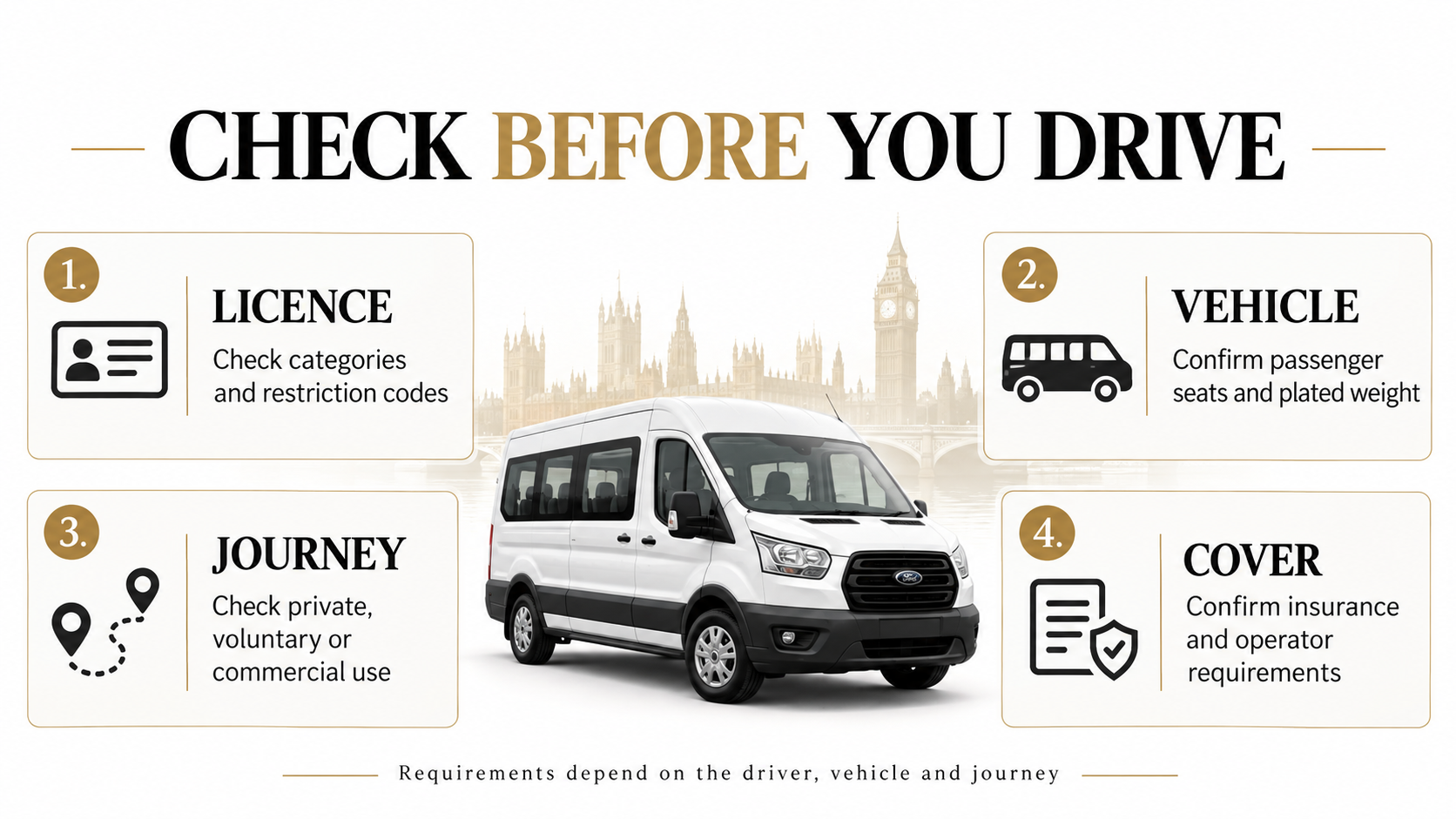
A practical checklist before booking
- Check the driver: confirm current categories, codes and any medical or renewal conditions.
- Check the vehicle: obtain passenger-seat capacity, MAM, transmission and any trailer details.
- Check the journey: explain who is travelling, who pays and whether the driving is voluntary or part of paid work.
- Check the cover: ask the insurer and hire company to confirm the proposed driver and use are accepted.
- Check the destination: do not assume a domestic entitlement or permit arrangement covers an overseas journey.
Keep those answers together with the booking. If one is uncertain, clarify it before collecting the keys rather than leaving the group to solve the problem on departure day.
Would a minibus with a driver be simpler?
For a family outing, airport transfer or one-off group trip, arranging a driver can remove the need to nominate someone from the group to self-drive. You can focus on passenger numbers, luggage, pickup points and the itinerary.
Read Travel offers minibus hire with a driver. Compare the practical differences in our driver hire versus self-drive guide, then request a quote for your journey. Give the team the passenger total, luggage requirements and any accessibility needs so the proposed transport can be checked against your plans.
Frequently asked questions
Do passengers need a special minibus licence?
No. If you are travelling as a passenger, you do not need driving entitlement for the vehicle. When organising a booking, confirm who provides the driver and the arrangements included.
Is a 17-seater automatically a Category D vehicle?
The label alone is insufficient. Establish whether it means 16 passengers plus the driver or 17 passenger seats, then check the full vehicle specification against the categories above.
Does a Section 19 permit mean anyone can drive?
No. The driver must still satisfy the applicable entitlement and eligibility requirements. Check the organisation’s service and the proposed driver separately.
Are Northern Ireland’s rules identical?
Do not assume every detail is identical. Drivers with a Northern Ireland licence should check nidirect’s minibus guidance, including its weight and eligibility conditions, and confirm their position with DVA where necessary.
Plan your group journey with Read Travel
You do not always need a new driving qualification, but you do need a clear answer for your particular driver, vehicle and trip. If you prefer to travel with a driver, explore Read Travel’s minibus hire options or call 020 3983 4906 to discuss your itinerary.
Related Services
Book your group transport with Read Travel across our full range of London services:
- Affordable Airport Transfers
- Corporate Coach Hire
- Private Coach Hire
- Party Coach Hire
- Wedding Coach Hire
- London Tour
Our Popular Fleet
Choose the right vehicle for your group size:


