Book a minibus for groups of 8–17 people and journeys under 4 hours. Book a coach for groups of 18 or more, long-distance travel, or when onboard amenities like WiFi, toilets, and extra legroom are required.
That is the direct answer. But the right choice depends on 5 factors: group size, journey distance, budget, vehicle access at your destination, and comfort requirements. This guide covers all 5 so you book the right vehicle the first time.
Quick Decision: Minibus or Coach?
| Your Situation | Choose |
|---|---|
| Group of 8–17 passengers | Minibus |
| Group of 18–30 passengers | Midi-Coach or Large Minibus |
| Group of 30–70 passengers | Coach |
| Group of 70+ passengers | Two Coaches or Coach + Minibus |
| Short local trip or airport transfer | Minibus |
| Long-distance or motorway journey (4+ hrs) | Coach |
| Narrow streets, rural roads, tight parking | Minibus |
| Onboard toilet, WiFi, or reclining seats needed | Coach |
| Tight budget, small group | Minibus |
| Large group — best cost per person | Coach |
What Is the Difference Between a Minibus and a Coach?
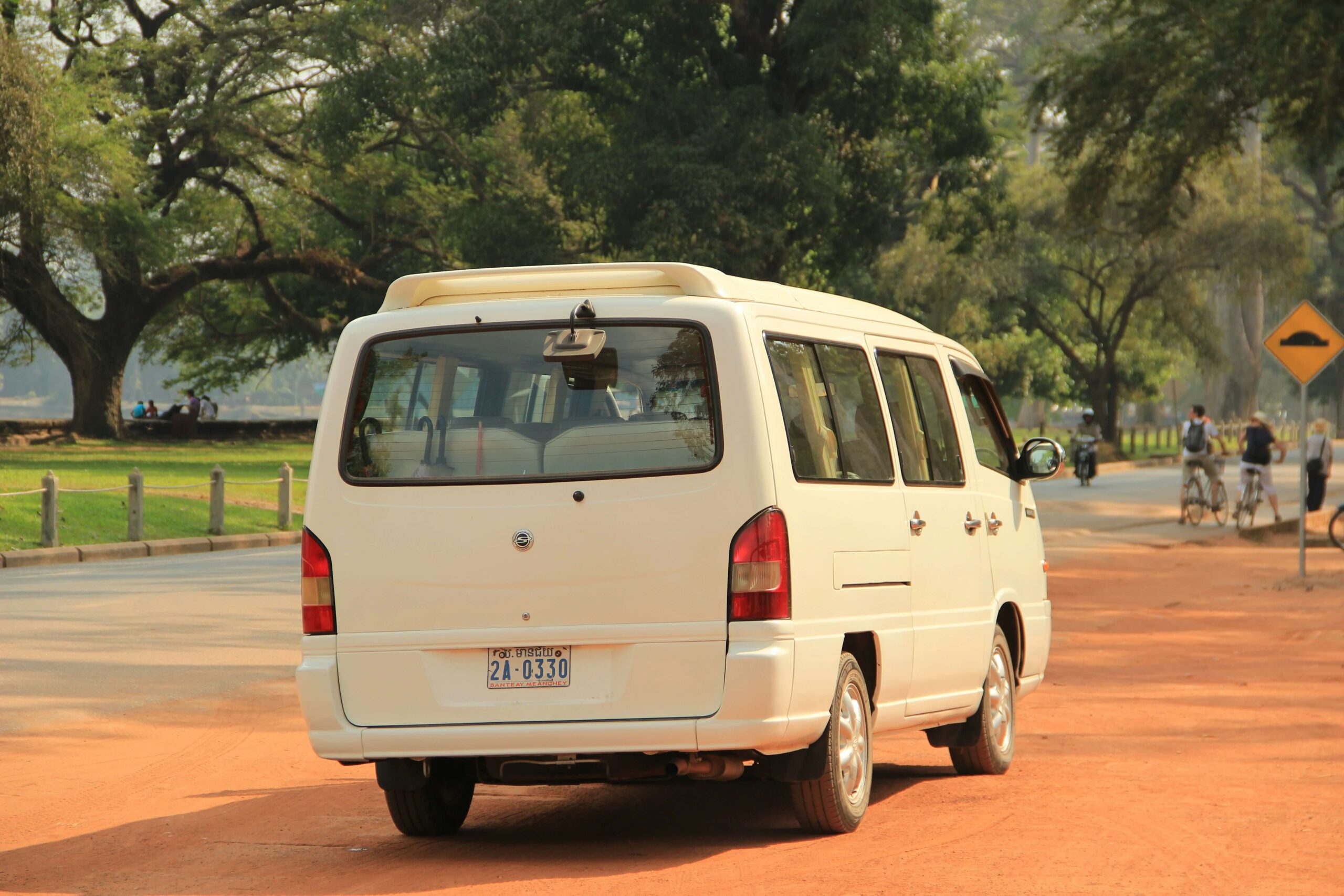
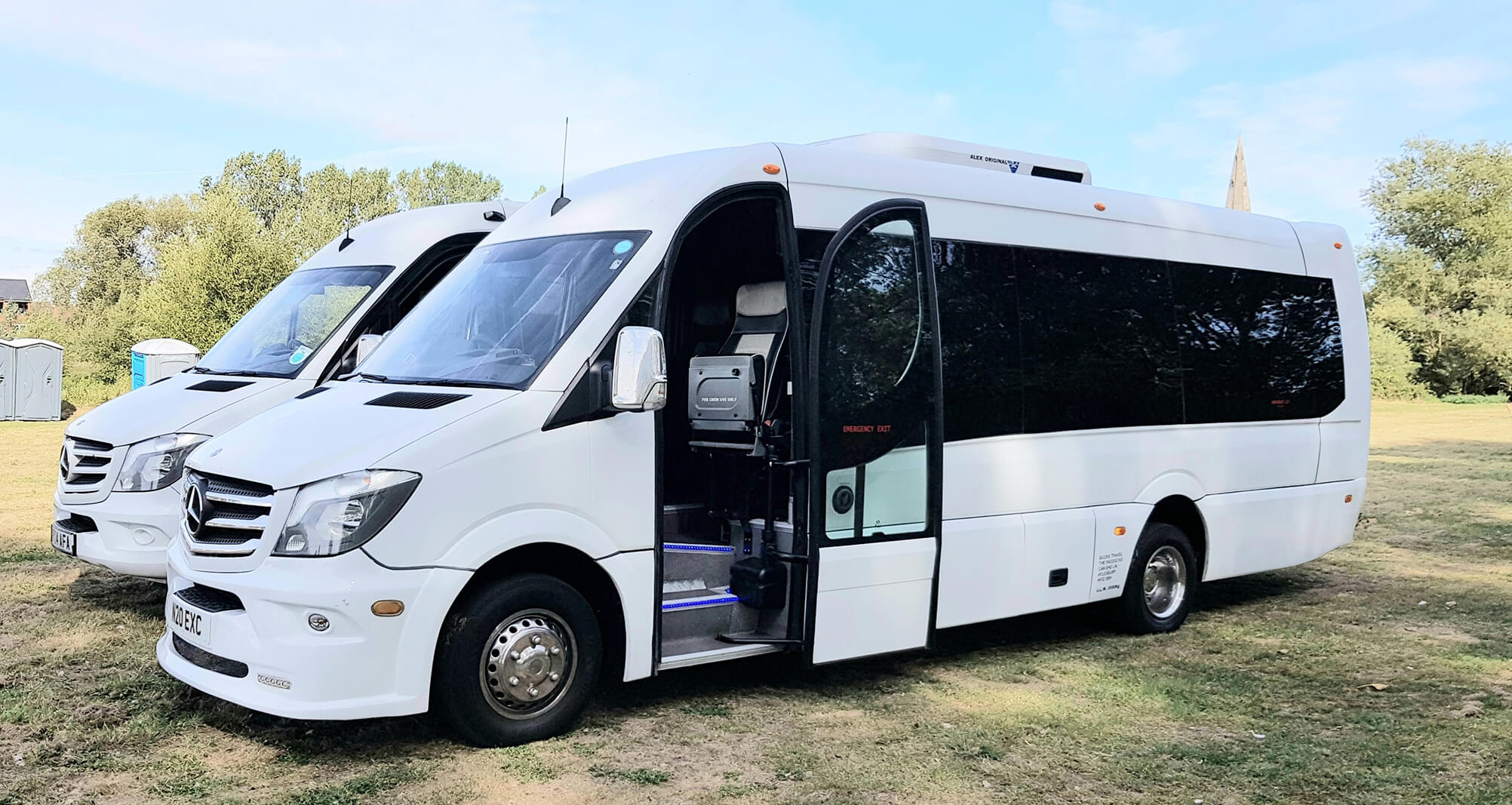
The key difference is size and purpose. A minibus carries 8–17 passengers (typically a Ford Transit or Mercedes Sprinter). A coach carries 18–100 passengers (typically a Volvo or Plaxton), with underfloor luggage storage, onboard toilets, and significantly more legroom per seat.
| Feature | Minibus | Coach |
|---|---|---|
| Passenger Capacity | 8–17 | 18–100 (single deck up to 70) |
| Typical Vehicles | Ford Transit, Mercedes Sprinter | Volvo, Plaxton, Setra |
| Journey Best Suited To | Local, short–medium distance | Long-distance, motorway |
| Luggage Storage | Limited (overhead / boot) | Large underfloor holds |
| Onboard Toilet | Not standard | Standard on most coaches |
| WiFi / USB Charging | Selective models only | Standard on most coaches |
| Reclining Seats | Selective executive models | Standard |
| Parking & Manoeuvring | Easy – fits most streets and car parks | Requires coach bays / larger spaces |
| Driver Licence Required | D1 entitlement | Category D + Driver CPC + medical |
| Hourly Hire Rate | £80–£100/hr | £100–£130/hr |
| Daily Hire Rate | £150–£500 | £350–£1,800 |
Factor 1: Group Size
Group size is the first decision point. A minibus suits 8–17 passengers. For groups of 18–30, a midi-coach (carrying 20–30 passengers) hits the sweet spot between a large minibus and a full-size coach. Groups of 30 to 70 need a standard coach. Groups exceeding 70 require 2 coaches, or a coach paired with a minibus.
A useful rule from operator experience: if your group fills fewer than 20 seats, a minibus costs less. If your group fills 30 or more seats, a single coach beats multiple minibuses on both cost and logistics.
Factor 2: Journey Distance and Duration
Minibuses handle local trips, airport transfers, and journeys up to roughly 2–4 hours without issue. Beyond that, the lack of a toilet, limited legroom, and fewer comfort features make a coach the more practical choice.
Real example: a group of 12 travelling from London to Bath for a day trip works perfectly in a 16-seat minibus at £200–£350. The same group travelling London to Edinburgh (7–8 hours each way) benefits far more from a coach with reclining seats and an onboard toilet.
| Journey Type | Distance / Duration | Best Vehicle |
|---|---|---|
| Airport transfer | Under 30 miles / under 1 hr | Minibus |
| Day trip (local) | 20–60 miles / 1–2 hrs | Minibus |
| Day trip (regional) | 60–150 miles / 2–4 hrs | Minibus or Midi-Coach |
| Long-distance day trip | 150–300 miles / 4–6 hrs | Coach |
| Overnight or multi-day | 300+ miles / 6+ hrs | Coach |
Factor 3: Cost and Value Per Person
A minibus costs less in absolute terms. A standard 16-seater runs £150–£400 per day; a 49-seater coach runs £700–£1,500. But per-person value tells a different story.
| Vehicle | Daily Hire Cost | Capacity | Cost Per Person (full) |
|---|---|---|---|
| 16-Seater Minibus | £250 | 16 | £15.63 |
| 29-Seater Coach | £600 | 29 | £20.69 |
| 49-Seater Coach | £1,000 | 49 | £20.41 |
| 70-Seater Coach | £1,400 | 70 | £20.00 |
When every seat is filled, per-person cost is broadly similar across vehicle types. The real cost trap is hiring a vehicle too large for your group — a half-empty 49-seater coach is expensive dead weight. Match vehicle size to actual passenger numbers.
For groups of 30 or more, a single coach costs 30–50% less per person than multiple minibuses, because driver costs, fuel, and hire fees are not doubled. See Read Travel’s full fleet options at readtravel.co.uk.
Factor 4: Comfort and Onboard Amenities
Minibus Comfort
Modern minibuses offer air conditioning, climate control, leather seats, and on executive models, Wi-Fi and entertainment screens. They are comfortable for journeys up to 3–4 hours. Luggage is stored overhead or in a rear boot, which limits capacity for groups with large bags, sports equipment, or overnight cases.
Coach Comfort
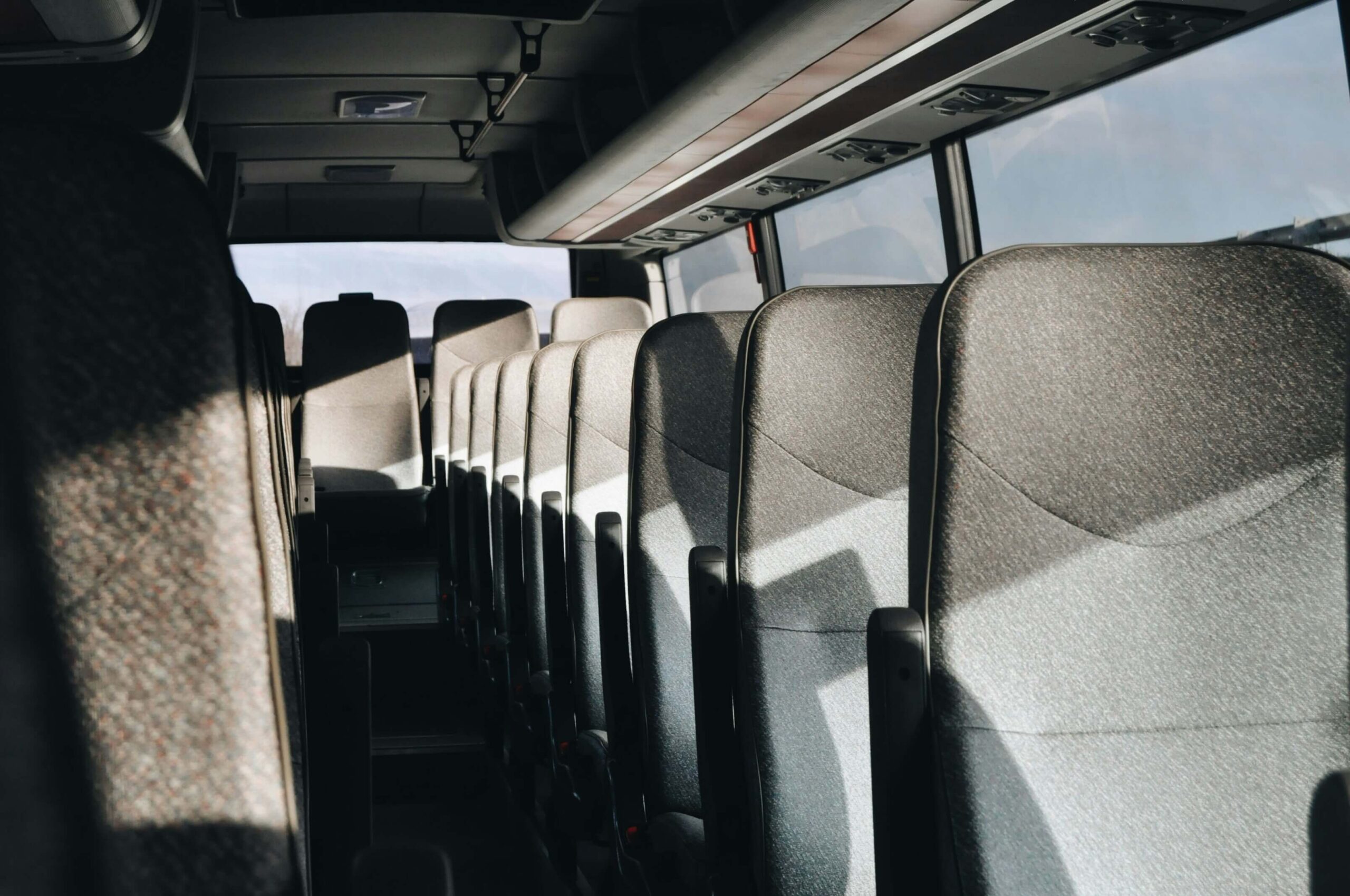
Coaches are built for long-distance comfort: reclining seats with footrests and adjustable headrests, generous legroom, underfloor luggage holds, onboard toilets, and on executive or luxury models, Wi-Fi, USB charging, individual screens, and hot drink facilities. The extra space and amenities make a 6-hour journey feel entirely different compared to a minibus.
| Amenity | Standard Minibus | Executive Minibus | Standard Coach | Luxury Coach |
|---|---|---|---|---|
| Air Conditioning | ✓ | ✓ | ✓ | ✓ |
| Reclining Seats | ✗ | ✓ | ✓ | ✓ |
| Onboard Toilet | ✗ | ✗ | ✓ | ✓ |
| WiFi | ✗ | Some | ✓ | ✓ |
| USB Charging | ✗ | ✓ | ✓ | ✓ |
| Underfloor Luggage Hold | ✗ | ✗ | ✓ | ✓ |
| Entertainment Screens | ✗ | Some | ✓ | ✓ |
| Extra Legroom | ✗ | ✗ | ✓ | ✓ |
Factor 5: Vehicle Access and Parking
Minibuses access narrow streets, residential pick-up points, rural venues, and standard car parks without restriction. A coach requires designated coach bays, wider roads, and additional turning space. In London, coaches must comply with Low Emission Zone (LEZ) requirements, which adds to operating costs in city-centre journeys.
If your route includes winding country lanes, a historic town centre, or a venue with restricted access, a minibus is the practical choice regardless of group size. If needed, a coach drops the group at the nearest accessible point while a minibus can drive directly to the door.
Driving Licences: What Do Operators Need?
This applies mainly to organisations hiring without a professional driver. For chauffeured hire, the operator handles all licensing requirements.
- Minibus (D1 entitlement): Many UK driving licences issued before 1997 include automatic D1 entitlement for non-commercial minibus use. Newer licences require a D1 test to drive a vehicle carrying 9–16 passengers for hire or reward.
- Coach (Category D + Driver CPC): Driving a coach commercially requires a full Category D licence, a Driver Certificate of Professional Competence (CPC), and a medical assessment. This is a professional qualification — not something a group member holds. All chauffeured coach hires include a fully qualified driver.
When to Choose a Minibus
- Groups of 8–17 passengers on any journey
- Airport transfers, short city hops, and local event transport
- Venues with limited parking or narrow access roads
- Budget-conscious groups where per-vehicle cost matters most
- Corporate shuttle runs, school trips, hen and stag parties
- Frequent stops or multiple pick-up / drop-off points
Read Travel operates 9 Seater Car Hire and 12 to 17 Seater Minibus Hire for groups across the UK.
When to Choose a Coach
- Groups of 18 or more travelling together
- Long-distance journeys (4+ hours) where comfort is a priority
- Trips where luggage, sports equipment, or overnight bags must travel with the group
- Events where an onboard toilet eliminates costly rest stops
- Corporate, school, or wedding transport for 30–100 guests
- Occasions where per-person cost efficiency for large groups matters
Read Travel offers 18–24 Seater Coach Hire, 29 Seater Coach Hire, 33 Seater Coach Hire, and 70 Seater Bus Hire.
When to Use Both: Coach + Minibus Combinations
Some group travel scenarios benefit from combining both vehicle types. A coach drops the main group at a venue while a minibus handles pick-ups from multiple locations. For groups of 75–85 passengers, a 70-seater coach paired with a 12-seater minibus covers everyone in a single coordinated booking.
Multi-vehicle bookings are also useful when the destination has coach-restricted access. The coach parks at the nearest suitable point, and a minibus shuttles smaller sub-groups to the door. Read Travel coordinates both vehicle types under a single booking.
Real Cost Examples: Minibus vs Coach
| Journey | Group Size | Vehicle | Estimated Cost | Per Person |
|---|---|---|---|---|
| London → Heathrow Airport (return) | 12 | 16-Seat Minibus | £200–£280 | £16–£23 |
| Birmingham → Brighton (day trip) | 20 | Midi-Coach (29-seat) | £500–£700 | £25–£35 |
| Manchester → London (long-distance) | 45 | 49-Seat Coach | £1,000–£1,300 | £22–£29 |
| School Trip (local, full day) | 30 | 33-Seat Coach | £500–£750 | £16–£25 |
| Wedding Guest Transfers | 50 | 70-Seat Coach | £800–£1,200 | £16–£24 |
Note: Prices are indicative UK market averages for 2026 and vary by operator, region, and peak-season demand.
Accessibility: Minibus and Coach Options
Both vehicle types are available in accessible configurations. Under the Equality Act 2010, group organisers must consider participants with mobility needs. Accessible minibuses include wheelchair ramps, low-floor entry, and adapted seating. Accessible coaches include lifts, designated wheelchair spaces, and carer seating. Both reduce standard passenger capacity to accommodate wheelchair users.
Confirm accessibility requirements at the point of booking. Accessible vehicles are in higher demand and book out faster than standard fleet. Read Travel accommodates accessibility requirements across all vehicle sizes.
Minibus vs Coach: 5 Common Questions
Is a minibus cheaper than a coach?
Yes for small groups. A minibus costs less in absolute terms. A coach becomes cheaper per person once your group exceeds 30 passengers and fills the coach.
Can I self-drive a coach?
Rarely practical. A coach requires a Category D licence, Driver CPC qualification, and a medical assessment. All commercial coach hires include a professional driver.
What is a midi-coach?
A midi-coach carries 20–30 passengers — the mid-point between a large minibus and a full-size coach. It offers more space than a minibus without the cost of a 49-seat vehicle.
Do coaches have toilets?
Yes. Most standard coaches include onboard toilets as standard. Minibuses do not, unless it is a specifically adapted luxury model.
Which is better for a school trip — minibus or coach?
A coach suits school trips of 25 or more pupils. The underfloor luggage hold accommodates bags and equipment, and the onboard toilet reduces the need for rest stops. Minibuses work well for smaller school groups or local outings.
Conclusion
Choose a minibus for groups of 8–17, short-to-medium journeys, tight access points, and budget-sensitive bookings. Choose a coach for groups of 18 and above, long-distance travel, and journeys where onboard comfort, toilets, and luggage space directly affect passenger experience.
The 5 deciding factors are: group size, journey distance, cost per person, vehicle access at your destination, and comfort requirements. Work through those 5 and the right answer is clear every time.
Read Travel operates the full UK group transport fleet — from 9-seater cars to 70-seat coaches — with professional drivers and transparent pricing. Get a free quote at readtravel.co.uk or call 0798 400 0000.